Backpressure in GraphQL is not primarily a gateway feature. It is a system-level control strategy for preventing fan-out, queue growth, and tail-latency amplification from turning localized overload into distributed failure (Wang et al., 2023; Zhuo et al., 2023).
Latency-Informed Backpressure Model
Backpressure should be driven by observed system behavior, not static request thresholds.
- Latency signals indicate emerging saturation
- Fan-out amplification increases systemic risk
- Backpressure must be applied before queues collapse
The key question is not “Is this request expensive?” but “Is the system already saturated?”
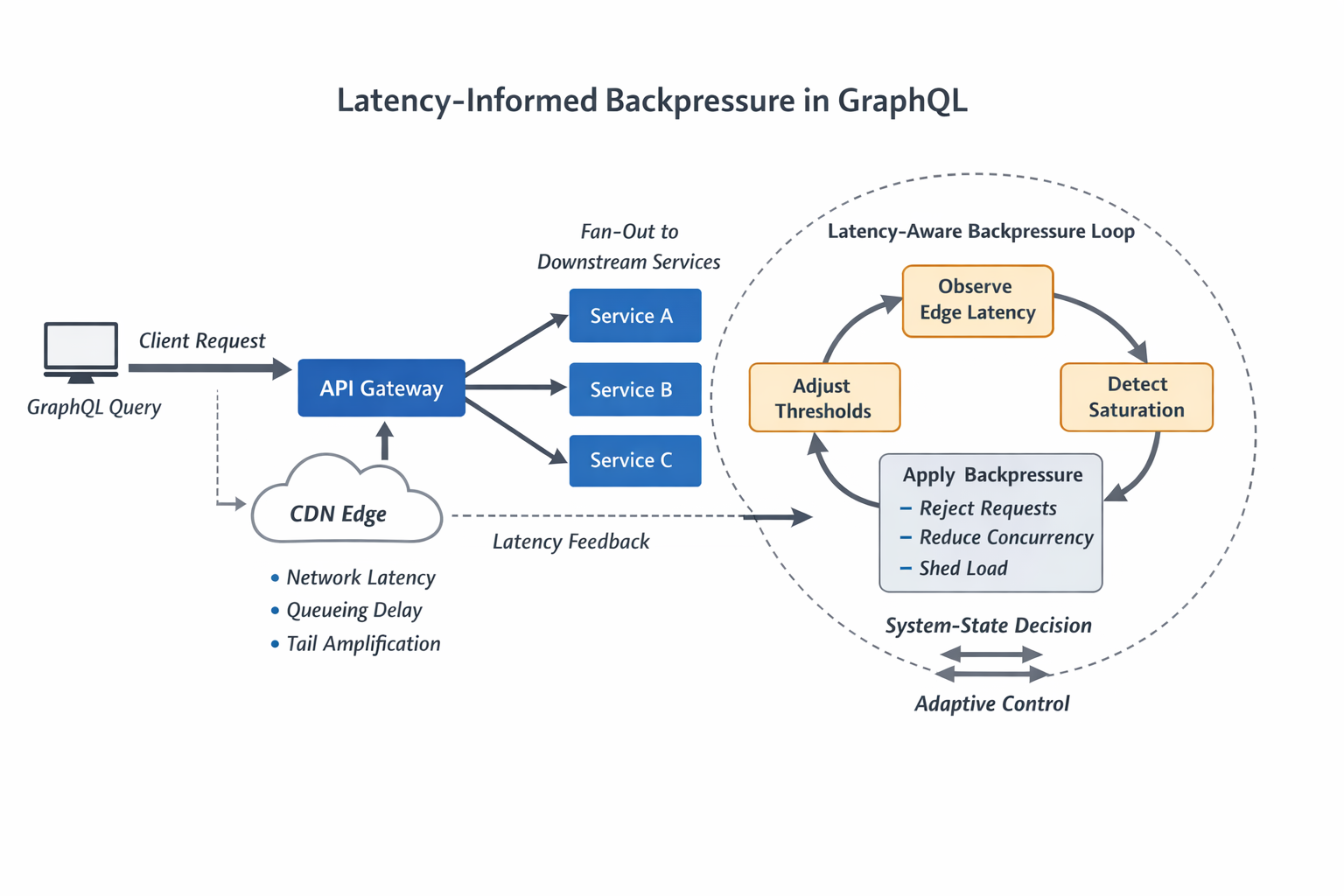
Backpressure in distributed systems is not primarily a mechanism for protecting individual services. It is a control strategy for preventing localized overload from amplifying into cascading failure across request graphs. In GraphQL systems, where a single query can fan out into multiple downstream services, backpressure must be informed by real-time latency signals and propagation effects rather than static rate limits alone (Wang et al., 2023; Zhuo et al., 2023).
GraphQL introduces structural risk because a single query can expand into a multi-hop request graph whose latency characteristics are dominated by downstream dependencies rather than the gateway itself (Wang et al., 2023). Under load, this creates a familiar distributed-systems failure pattern: queue buildup, tail-latency amplification, and eventual saturation across dependent services (Wang et al., 2023; Zhuo et al., 2023).
Why GraphQL Makes Backpressure Hard
GraphQL complicates backpressure because request cost is not directly observable at the edge. A query that appears small at the API layer may trigger deep execution trees, multiple downstream calls, and unpredictable latency amplification once resolver fan-out is expanded through the backend dependency graph (Wang et al., 2023).
Unlike endpoint models with relatively fixed execution paths, GraphQL requests are shaped dynamically. That makes purely static admission controls incomplete, because a system cannot reliably infer the downstream resource impact of a query before execution. The result is a mismatch between request acceptance and actual system load, which is a common precursor to instability in overloaded distributed systems (Wang et al., 2023; Zhuo et al., 2023).
CDN Latency as a Leading Signal
Latency observed at the CDN or edge layer provides a near-real-time signal of end-to-end request behavior, allowing systems to detect saturation earlier than service-local metrics alone. In request graphs with multiple downstream dependencies, edge-observed latency reflects not only gateway behavior but also queueing effects, downstream contention, and user-visible tail behavior (Wang et al., 2023; Zhuo et al., 2023).
This matters because service-local metrics often tell operators that a system is already degraded, while user-facing latency begins to drift earlier. In that sense, latency is not merely a symptom of stress. It is a control signal that can be used to shift backpressure decisions earlier in the lifecycle of overload.
Latency-Driven Backpressure Policy
A practical backpressure policy can be expressed as a ratio between observed latency and an established baseline:
P = L_observed / L_baselineThat ratio can then be used to progressively tighten execution policy as saturation increases:
- P < 1.2 → normal execution
- 1.2 ≤ P < 2 → reduce query depth and fan-out
- 2 ≤ P < 3 → allow degraded or partial responses
- P ≥ 3 → reject requests or shed load
The architectural point is not that these thresholds are universal. It is that backpressure should react to system state rather than static request classification. In distributed services, the important question is rarely whether a request is intrinsically “bad.” It is whether the system is already close to collapse.
Architecture
The architectural path is straightforward:
Client → CDN → GraphQL Gateway → Execution Engine → Downstream Services
The key design principles are:
- Edge-driven feedback: use observed latency to infer emerging saturation
- Stateless enforcement: make admission or degradation decisions from current system signals
- Graceful degradation: reduce scope before the system reaches failure
This model is effective because the gateway sits at the boundary where request intent meets system condition. That makes it the natural place to translate latency signals into execution policy.
Implementation Sketch
The implementation mechanism is simple: extract timing signals, compute a pressure ratio, and map that ratio into execution constraints. The article’s code example should remain, but the reader should understand it as policy translation rather than mere parsing logic.
function extractLatency(headers) {
  const timing = headers['server-timing'] || '';
  const cacheStatus = headers['cf-cache-status'] || null;
  const originMatch = /(?:^|,)\s*origin;dur=(\d+(?:\.\d+)?)/.exec(timing);
  const edgeMatch = /(?:^|,)\s*edge;dur=(\d+(?:\.\d+)?)/.exec(timing);
  return {
    cacheStatus,
    originLatency: originMatch ? parseFloat(originMatch[1]) : null,
    edgeLatency: edgeMatch ? parseFloat(edgeMatch[1]) : null
  };
}

function computeMaxDepth(p) {
  if (p < 1.2) return 10;
  if (p < 2) return 6;
  if (p < 3) return 3;
  return 1;
}
What matters architecturally is not the specific parsing code. It is the control loop: observe latency, detect saturation, constrain execution, and continuously re-evaluate system state.
Tail Latency and Amplification Effects
Tail latency dominates user experience in distributed systems because slow requests propagate across service boundaries and amplify through fan-out structures. In deep request-response graphs, slow outliers disproportionately shape overall behavior and can destabilize the system long before average latency becomes alarming (Wang et al., 2023; Zhuo et al., 2023).
GraphQL intensifies that problem because a single slow downstream service can delay the full response, retries can multiply load, and concurrent fan-out can increase contention across shared backends. The resulting loop is familiar: latency rises, queues build, retries amplify demand, and saturation accelerates. Effective backpressure must interrupt that loop before the system enters visible collapse (Wang et al., 2023).
Trade-Offs
Latency-driven backpressure is not free of trade-offs. Latency is a composite signal, so it reflects multiple causes at once: network variation, backend contention, queueing, and request complexity. That makes attribution harder even when the signal is operationally useful.
Aggressive backpressure can also reduce throughput and produce degraded or partial responses if thresholds are poorly tuned. But these are governance and calibration problems, not arguments against the model itself. The relevant comparison is not “perfect throughput versus degraded responses.” It is graceful control versus uncontrolled saturation.
Strategic Takeaways
Backpressure in GraphQL should not be treated as a static configuration problem. It is a control problem shaped by workload behavior, request-graph topology, and latency amplification. CDN-observed latency is valuable because it allows systems to shift admission and degradation decisions earlier—before queues collapse and downstream services destabilize.
The key architectural shift is from request-based control to system-state-based control, and from static limits to adaptive feedback loops. That shift is what allows systems to remain stable under unpredictable or adversarial load.
Final Thought
Backpressure is not fundamentally about rejecting requests. It is about preserving system integrity under stress. In GraphQL systems, where substantial complexity can hide behind a single endpoint, latency is more than an outcome metric. It is one of the earliest signals that the request graph is moving from healthy fan-out into unstable amplification.
Used that way, latency becomes not just a symptom of overload, but part of the control surface of the system itself.
What to Read Next
For the broader platform context, see Cloud Platform Engineering: APIs, Delivery, and Operations.
If you want the simpler on-ramp, start with API Backpressure Explained Simply. For the wider systems framing, see Backpressure in Distributed Systems: Stability, Correctness, and Graceful Degradation. For a neighboring latency-attribution treatment, continue with Latency-Aware Backpressure with Server-Timing in CDN-Fronted Distributed Systems.
References
- Alizadeh, M., Greenberg, A., Maltz, D. A., Padhye, J., Patel, P., Prabhakar, B., Sengupta, S., & Sridharan, M. (2010). Data center TCP (DCTCP). In Proceedings of the ACM SIGCOMM 2010 Conference. https://dl.acm.org/doi/10.1145/1851182.1851192
- Cardwell, N., Cheng, Y., Gunn, C. S., Yeganeh, S. H., & Jacobson, V. (2017). BBR: Congestion-based congestion control. https://queue.acm.org/detail.cfm?id=3022184
- Wang, Z., Jiang, H., Chen, K., Wang, X., Li, P., & Stoica, I. (2023). TailGuard: Tail latency SLO guaranteed task scheduling for deep request-response services. In IEEE ICDCS 2023. https://ranger.uta.edu/~jiang/publication/Conferences/2023/TailGuard-ICDCS23.pdf
- Zhuo, H., Zhang, Y., Xiong, J., & others. (2023). TailWAG: Tail latency workload analysis and generation. In ACM/SPEC International Conference on Performance Engineering. https://dl.acm.org/doi/pdf/10.1145/3583060.3583170